In this section
- RulesLaws by stateIs plug-in solar legal in your state? Status, bill number, start date and size cap for all 50 states and D.C., checked Nov 4, 2026.
- CalculatorSavings calculatorHow much would a balcony solar kit save in your state? Uses NREL sunshine data and your electricity price, or an exact PVWatts estimate for your ZIP code.
- GuideUL 3700 certificationWhat UL 3700 tests, which plug-in solar products are certified so far, and which states require it.
- GuideRenters' guideWhich states protect renters who want plug-in solar, what your lease can still say, and a template letter to ask your landlord.
How it works
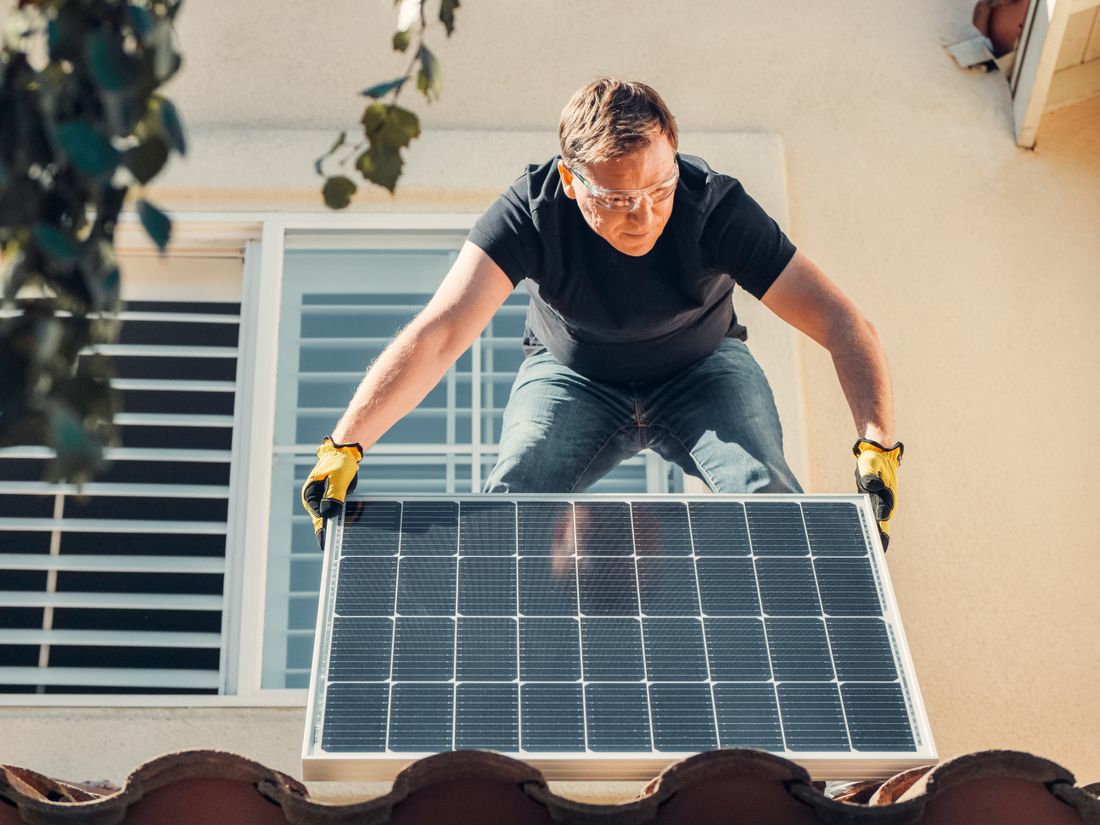
A plug-in kit is one to four solar panels wired to a microinverter, which turns the panels’ DC power into household AC and feeds it through an ordinary outlet. Whatever your home is using at that moment, the fridge, the router, a laptop, runs on the solar first, and your meter spins more slowly.
The inverter is the safety-critical part. It has to stop sending power the instant the grid goes down, so it can’t energize lines that utility crews are working on. That’s what the new UL 3700 safety standard tests for.
Where it's legal
Ten states have passed laws that let you connect a small kit without your utility’s approval:
- In effect now: Utah, Maryland, Vermont, Maine, Colorado and Connecticut.
- Signed, starting soon: California, Virginia and New Hampshire on Jan 1, 2027; New Jersey around March 1, 2027.
- Passed, not yet signed: New York.
Most laws cap a kit at 1,200 W. Colorado allows 1,920 W; Maine allows 420 W on your own and up to 1,200 W with an electrician. Everywhere else, a kit counts as a grid connection under your utility’s rules for rooftop solar. Every state’s status.
What it saves
A typical 800 W kit on a south-facing balcony railing makes roughly 600 to 1,000 kWh a year, depending on where you live. At the average U.S. price, that’s about $90 to $160 a year, and more in high-price states like California, Massachusetts and Maine. Kits cost about $300 to $1,500, so payback runs from about three years to more than ten.
The catch is timing. A kit only saves money on power you use while the sun is up. Anything your home isn’t using at that moment flows out to the grid, and most of these laws don’t pay you for it. A household’s always-on load, the fridge, router and devices in standby, is often 100 to 200 W (NRDC measured an average of 164 W in California homes), so small kits are usually used almost entirely at home. Run the numbers for your state or ZIP code.
Before you buy
- Check your state’s rules, including any notice you have to give your utility and, if you rent, your landlord. Renter rules.
- Check certification. Several laws require UL 3700 or an equivalent listing, and California requires the whole system to be certified. As of our last check, certified microinverters exist but we couldn’t confirm a complete kit certified as a whole system. What UL 3700 means.
- Plug straight into a wall outlet. Never into an extension cord or power strip, and don’t share the circuit with big loads like a space heater.
- Point the panels south if you can. East or west costs about 20%; north-facing rarely pays off.
What to buy
Most of the plug-in kits that matter are sold directly by their makers, not on Amazon. If your state doesn’t allow plug-in kits yet, the legal workaround is a power station charged by portable panels: it never connects to your home wiring.
Links marked “Paid link” go to Amazon. As an Amazon Associate we earn from qualifying purchases, at no cost to you. We don’t show prices because they change hourly.
Bright Saver plug-in solar kit
Lowest-cost kit built around a UL 3700 microinverter
- Hoymiles HiFlow Pro microinverter, certified to UL 3700 in July 2026
- Sold at cost by a nonprofit membership
Bright Saver also runs the most-cited state law tracker. Its kit uses the first microinverter certified to the plug-in solar standard.
Watch for: Sold by Bright Saver, not on Amazon. No link from us earns anything.
APsystems EZ1 plug-in microinverter
Building your own kit with certified parts
- CSA-certified to UL 3700
- Pairs with standard panels
The second microinverter we could confirm with UL 3700 certification. Good if you already have panels.
Watch for: A certified inverter isn't the same as a certified complete kit. California requires the whole system to be certified.
EcoFlow STREAM plug-in system
Plug-in solar with a battery
- Microinverter or microinverter-plus-battery versions
- Sold through EcoFlow's US store
A battery stores midday solar for the evening, so less of your output is exported unpaid.
Watch for: Check its certification status for your state before you buy; it changes as labs finish testing.
P3 Kill A Watt P4400 meter
Measuring your always-on load before buying a kit
- Plugs in between an appliance and the outlet
- Shows watts and kWh
A plug-in kit only saves money on power you use while the sun is up. Measure your fridge, router and other always-on loads first.
Watch for: For appliances only. Don't plug a solar inverter into it.
EcoFlow 220W bifacial portable solar panel
Solar where plug-in kits aren't legal yet
- Folding, with a kickstand
- Charges EcoFlow and most power stations with an adapter
Charging a power station doesn't connect anything to the grid, so it works in every state and every lease.
Watch for: Saves far less than a grid kit, because you have to carry the stored power to your devices.
Jackery SolarSaga 200W portable panel
Pairing with a Jackery power station
- Folding panel with kickstands
- Designed for Jackery Explorer units
The simplest panel-and-battery pair if you already own a Jackery.
Watch for: Check the connector your power station needs before buying another brand.